

You can download this publication or read it on the page below.
On this page
-
…
Introduction
Radioactive materials are routinely transported around the world by air, sea, road and rail, with over 20 million shipments annually. In New Zealand these materials include radioactive sources used in medicine, industry, research and education.
International regulations are in place to ensure that:
- the chances of an accident that results in radioactive material being dispersed in the environment are minimal, and
- workers involved in transport, including handlers and drivers, are protected in both normal and accident conditions.
All transport of radioactive material on public roads in New Zealand occurs under a legislative framework consisting of the Code of Practice for the Safe Transport of Radioactive Material (ORS C6) and the Land Transport Rule: Dangerous Goods 2005 (the DG Rule). ORS C6 incorporates by reference the latest edition of the International Atomic Energy Agency Regulations for the Safe Transport of Radioactive Material (IAEA Transport Regulations).
In addition, transport operations must comply with the relevant requirements of the Code of Practice for the Security of Radioactive Material (ORS C5).
The legislative framework provides the authoritative source of requirements for transportation of radioactive material. this Quick Reference Guide is an overview of these requirements provided as an aid only.
Handling radioactive material packages
Radioactive material presented for transport is packaged in accordance with the IAEA Regulations. This ensures that it is safe to handle under normal conditions. Nevertheless, there are certain basic instructions you should follow to prevent unnecessary exposure to radiation. The exposure you receive depends on how long you stay near, and how close you are, to the package of radioactive material. To minimise radiation exposure:
- Keep your contact time with the package short.
- Handle a package of radioactive material without delay – keep it moving.
- Do not stand around, sit near or sit on a package of radioactive material.
- Do not carry out time-consuming tasks, such as paperwork, near a package.
- Keep yourself and other persons as far away as practicable from packages.
- Store packages well away from offices, rest rooms and occupied work areas.
- Do not store packages with transport indices that add up to more than 50 in the same location. You will find the transport index written on the Category II or Category III yellow label (see Package labelling).
Who may transport radioactive material packages?
For all radioactive material packages, apart from ‘excepted packages’ (see below), drivers must either:
- have a DG endorsement on their driver licence, or
- be authorised under the Radiation Safety Act 2016 to use the radioactive material and be carrying the goods as ‘tools of trade’ under the DG Rule.
What is ‘tools of trade’
Schedule 1 of the DG Rule defines the maximum quantity of a dangerous good that can be carried as ‘tools of trade’ without a dangerous goods endorsement on a driver licence. For most dangerous goods these quantities are specified in terms of mass or volume, however this is not applicable for radioactive material, so the ‘maximum quantity’ is that permitted by the IAEA Transport Regulations.
The IAEA regulations set out a range of package designs and specify the maximum activity of each radionuclide that may be carried in each package design for material in both non-dispersible special form (the A1 limit) and for sources in a dispersible form (A2 limit). These limits take into account both the external radiation hazard and the radiotoxicity of the material.
Two examples of packages that are commonly transported as tools of trade are portable nuclear gauges used to measure compaction of roading (Type A package), and industrial radiography gamma cameras used to inspect welds (Type B(U) package). Both normally contain sealed sources in special form well below the maximum permitted by the respective package designs and are therefore permitted to be carried as tools of trade.
It is recommended that people who transport radioactive material as tools of trade carry evidence of their authorisation to do so under the Act to facilitate Police vehicle stops and allow the driver to proceed without delay. This would either be a copy of the use licence, or a copy of the written instructions issued by the authorised person.
When completing a Shipper’s Declaration state ‘tools of trade’ as the consignment number and ensure the consignor and consignee are both the same including the address of the storage facility.
Before transport starts
- Ensure that a completed and signed Road/Rail/Marine Shipper’s Declaration for DG – Class 7 Radioactive Material is included with the transport documents. This is a special version of a DG declaration that includes additional information to identify radioactive material. A copy of the declaration must be carried in the cab of the vehicle as required under 5.1(3) of the DG Rule.
- Check that all packages appear to be in sound condition, undamaged and not leaking.
- Check that each package is clearly labelled with category labels indicated in figures 1 to 3 (refer Package labelling below) on two opposite sides and is marked with the proper shipping name.
- Check that each package is clearly marked with the consignor and/or consignee name and address, the appropriate UN number and the gross mass of the package if it exceeds 50 kg.
- Vehicles must display placards in a prominent position on the front and rear of the vehicle (refer Vehicle placard below). Additional placards may also be displayed on the sides of the vehicle.
- Ensure that any packages are fixed securely in the vehicle in a position as remote as practicable from the driver (see During and after transport and Security during transport).
- Transport operators who carry DG for hire or reward must comply with the segregation requirements in section 6 of the DG Rule – that is, class 7 radioactive material must not be loaded:
- in the same freight container or on the same vehicle as class 1, 2.1, 3, 4.1, 4.2, 4.3, 5.2 or 8 DG
- in the same freight container or closer than three metres to class 5.1 DG, if loaded on the same vehicle.
- People who carry radioactive material as tools of trade must ensure that they are separated as much as possible, within the load space, from incompatible DG (those listed in 7a and 7b).
- It is recommended that people who transport radioactive material as tools of trade carry a copy of the use licence, or a copy of the written instructions issued by the authorised person to facilitate Police vehicle stops.
- Carry emergency response information, in accordance with section 8.3 of the DG Rule.
- The driver must have a mobile phone or two-way radio.
- Ensure the vehicle has sufficient fuel/charge for the journey prior to beginning transport.
Note: Items 1, 3, 5, 7, 8, 9 and 10 do not apply to excepted packages (refer Excepted packages for further information).
During and after transport
- Keep in mind that you are transporting radioactive material so take extra care to drive safely and defensively.
- Ensure that the journey from the point of collection to the point of delivery is as direct as possible.
- No person other than the driver and any other person who is directly involved the use of the gauge may travel in a vehicle carrying radioactive material.
- Packages must be securely restrained in the vehicle using methods such as a well, stillage, or ratchet tie down as appropriate so that they do not move under heavy braking. The following options would also enhance the physical security of a package:
- a locked toolbox secured to the vehicle
- a locked metal frame secured to the vehicle
- a locked chain, thicker than 7mm, passed through the package handles or other secure fixing points.
- Remove any vehicle placards immediately after the packages have been unloaded.
Security during transport
Security requirements are set out in the Code of Practice for the Security of Radioactive Material ORS C5.
Do not leave vehicles containing radioactive materials unattended for any longer than is necessary. If unattended ensure the vehicle is locked in a safe and secure location, with the package obscured from view. In addition, the vehicle should be fitted with a suitable alarm system, which should be set whenever the vehicle is left unattended.
Ensure all persons directly involved with the consignment are briefed on the specific requirements relating to their duties on a need to know basis. Consignments that meet the threshold for enhanced security requirements must have a security plan with additional specific requirements that must be followed during transport.
Breakdowns and accidents while carrying radioactive material packages
If the following information is attached to the DG declaration, it will satisfy the requirement of the DG Rule for emergency response information.
- In all cases priority should be given to treating any people injured as a result of an accident.
- If there is definitely no damage to the radioactive load, no special action is necessary beyond making appropriate arrangements to complete the journey as soon as possible.
- If there is, or might be, damage to the radioactive load, proceed as follows.
- Inform FENZ (Fire and Emergency NZ) (111) and the Ministry of Health’s emergency contact (021 393 632) of the accident. State the number of radioactive packages being carried and quote the transport index and name(s) of radioisotope(s) as detailed on the Shipper’s Declaration.
- Keep yourself and others away from, and avoid handling, any radioactive material packages.
- Advise the emergency services and breakdown crews in attendance that the vehicle in question has radioactive material on board.
- If you have touched a damaged package or objects near it, wash your hands thoroughly and have yourself checked for possible contamination before you leave the scene.
- Do not eat, drink, smoke, vape or leave until checked for possible contamination.
- Note any vehicles involved in the accident – the vehicles should remain at the accident site until cleared by the police or a competent person.
- Observe any instructions given on the Shipper’s Declaration.
Package labelling
Minimum size for the package category labels is 100 mm x 100 mm on two opposite sides of the package, or all four sides in the case of a freight container. The labels shall be completed with the contents being the name of the radionuclides, the maximum activity of the content in becquerels and the Transport Index (TI) which is the maximum dose rate in mSv/h at 1m x 100.
| Category | Conditions | |
|---|---|---|
| Transport index1 | Maximum surface radiation level | |
| I | 02 | 0.005 mSv/h |
| II | Over 0 up to 1 | 0.5 mSv/h |
| III | Over 1 up to 10 | 2 mSv/h |
| III3 | Over 10 | 10 mSv/h |
- The transport index is a single number assigned to a package containing radioactive material and is the maximum dose rate at one metre from the package in mSv/h x 100.
- If the measured transport index is 0.05 or less then the quoted value may be zero.
- Goods with a transport index greater than 10 may only be transported on an individual basis with the prior written authorisation of the Office of Radiation Safety.
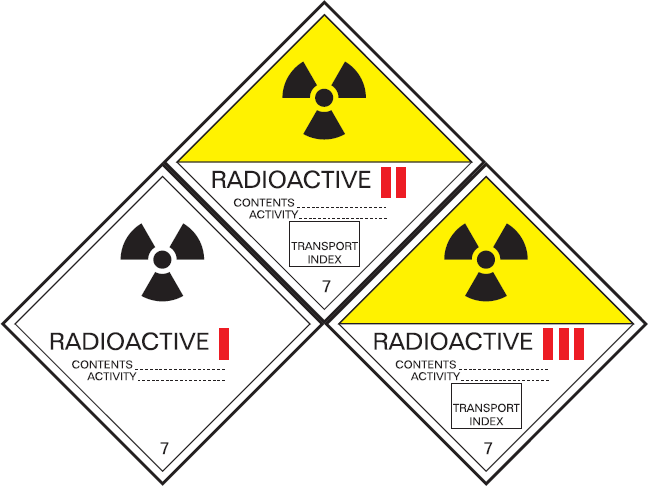
Figure 1: Transport category labels
Vehicle placard
Minimum dimensions of placard 250 mm x 250 mm, except when the design of the vehicle or the load does not allow this, for example if it interferes with the vehicle safety sensors.
All vehicle placards must be clean, unobscured and positioned substantially vertically on a contrasting background on the vehicle so that the nature of the load can be readily identified from a distance of 25 m in daylight.
The fitting of placards must not negatively affect the safe operation of a vehicle. While it is the responsibility of the driver to operate a safe vehicle, if a vehicle is modified to affix a placard holder it is the responsibility of the modifier to ensure vehicle safety is maintained.
The number ‘7’ shall not be less than 25 mm high.
The use of the word ‘RADIOACTIVE’ in the bottom half is optional and the placard may alternatively display the appropriate United Nations number for the consignment.
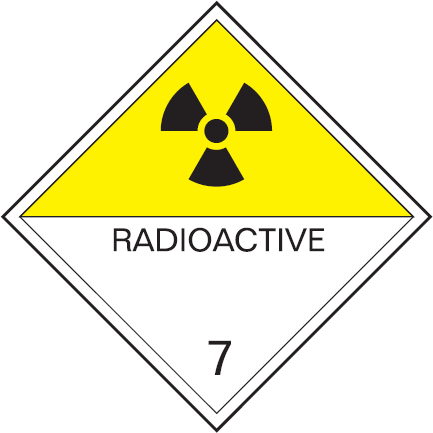
Figure 2: Vehicle placard
Excepted packages
Excepted packages are packages that contain limited quantities of radioactive material, or contained in instruments or manufactured articles, or empty packages that previously contained radioactive material. They are designed to withstand normal handling conditions during transport, but not accident situations.
The radioactive content permitted in excepted packages by the IAEA Regulations is very limited so that in the event of the package being damaged, the radiological hazard is minimal.
Common examples of the content of excepted packages include a vintage watch with a radium painted dial or small check sources that are used to verify the function of a radiation survey meter.
The packaging for excepted packages must be designed to meet IAEA requirements and be marked with the UN number but does not need a transport category label. A transport document (consignment note) is also required and must also include the UN number. However, the Office of Radiation Safety considers that, provided they comply with these requirements, excepted packages are not a significant risk during transport. Consequently, in accordance with 1.2 (3) of the DG Rule, the Office of Radiation Safety has declared that excepted packages complying with IAEA requirements do not need to be transported as DG on land in NZ.
This means that vehicles do not have to display placards, a Shipper’s Declaration is not required, drivers do not require a DG endorsement on their driver licence and do not need to be authorised for use under the Radiation Safety Act 2016.