
Terms of Reference for the WHO Code of Compliance Panel
View text
Introduction
- The World Health Organization (WHO) International Code of Marketing of Breast-milk Substitutes (the WHO International Code in New Zealand) is implemented, to the extent agreed by Government, through three voluntary codes and one mandatory code:
- the Infant Nutrition Council Code of Practice for the Marketing of Infant Formula in New Zealand (the INC Code of Practice), which covers the activity of marketers and importers of infant formula products
- the Code of Practice for Health Workers (the Health Workers’ Code), which covers advice about infant feeding provided to families by any health worker or organisation
- the Code for Advertising of Food (administered by the Advertising Standards Authority), which covers advertisements in any media for toddler milk products (aged 12+ months)
- the Australia and New Zealand Food Standards Code (administered by the Ministry for Primary Industries), which is a mandatory code covering the safe manufacture and labelling of food products, including infant formula.
Purpose of this terms of reference
- This document sets out the:
- objectives and purpose of the WHO Code Compliance Panel (the Panel)
- accountability
- appointments (including composition, term of office and resignation/removal from office)
- processes for the management of interests, confidentiality and communications
- meeting procedures including frequency of meetings, quorum, decision-making procedures and the role of the secretariat
- performance measures
- reporting
- fees.
Objectives
- The Panel’s objectives are to:
- determine compliance with the INC Code of Practice and the Health Workers’ Code including providing advice on early concerns that may not have been provided as a complaint
- provide advice to the Public Health Agency on issues that arise about implementing and monitoring the New Zealand response to the WHO International Code in New Zealand
- advice may include recommendations that the Public Health Agency take further steps to promote the Code in New Zealand such as writing to individuals or organisations that may be operating in New Zealand in a way that is not consistent with the WHO International Code in New Zealand
- advice may also include recommendation to the Public Health Agency as to potential changes the New Zealand government might wish to consider regarding New Zealand’s approach to implementing the WHO international Code.
- ensure the principles of te Tiriti o Waitangi are upheld
- contribute to a wider policy environment that supports the provision of safe and adequate nutrition for infants by the protection and promotion of breastfeeding, ensuring the proper use of breast-milk substitutes when these are necessary, and support for effective implementation and monitoring of the New Zealand response to the WHO International Code in New Zealand and the implementation of the National Breastfeeding Strategy.
Principles of te Tiriti o Waitangi
- The Panel recognises the special relationship between the Crown and Māori under te Tiriti o Waitangi. The Panel seeks to operate in accordance with the Ministry of Health’s te Tiriti o Waitangi framework (see Appendix A) and to uphold the principles of te Tiriti o Waitangi, as articulated by the Courts and the Waitangi Tribunal, by:
- Tino rangatiratanga: the Panel supports the right of Māori to receive advice and support for breastfeeding and safe infant feeding information and the right to exercise self-determination in decision-making over health and wellbeing and the health and wellbeing of whānau. The Panel includes tangata whenua members.
- Equity: the Panel recognises that equity is a key contributor to improving infant health outcomes for Māori. It supports equity by ensuring that health workers offer support and advice about breastfeeding and infant feeding that complies with the Health Workers’ Code.
- Active protection: the Panel is committed to being well-informed about how its work can support Māori health outcomes and to seeking guidance where needed.
- Options: the Panel contributes to a system in which Māori have breastfeeding and infant feeding care that enables them to uphold their tikanga or cultural practice. The Panel reviews and ensures that it is following culturally appropriate processes in its work.
- Partnership: the Panel considers partnership in the establishment of the complaints decision-making process. This includes working with tangata whenua and whānau where appropriate in its processes.
Purpose
- The purpose of the Panel is to:
- support education about the implementation of the complaints processes under the INC Code of Practice and the Health Workers’ Code
- make decisions on complaints referred to the Panel that relate to either the INC Code of Practice or the Health Workers’ Code
- provide advice on appropriate action to remedy a breach of either of the Codes including:
- finding a breach of the relevant article(s) of the INC Code of Practice
- providing education to support a health worker to better understand their obligations under the Health Workers’ Code
- finding a breach of the relevant article(s) of the Health Workers’ Code
- referral to the relevant health practitioner regulatory authority, the Health and Disability Commissioner, Health New Zealand or the health worker’s employer for breaches of the Health Workers’ Code
- provide advice to the Public Health Agency on issues related to implementing the WHO Code in New Zealand including, but not limited to, complaints that are outside the scope of either the INC Code of Practice or the Health Workers’ Code.
- From time to time, the Panel receives advice or complaints that are relevant to its work but for which a different approach is taken.
- An issue of concern is raised but a formal complaint is not made: the Panel will seek advice from the INC or the health worker about the circumstances of the concern and provide advice to the person who raised the concern.
- A complaint is made under the INC Code of Practice but the subject of the complaint is not a member of the INC: the Panel will refer the complaint to the INC and advise the complainant and the subject of the complaint that this action has occurred.
- A complaint is made by one INC member about another INC member: the Panel will refer the complaint to the INC for resolution and the INC will provide advice about the complaint and its remedy to the Panel for its information and inclusion in the annual report.
The complaints and appeal process
Process for considering a complaint
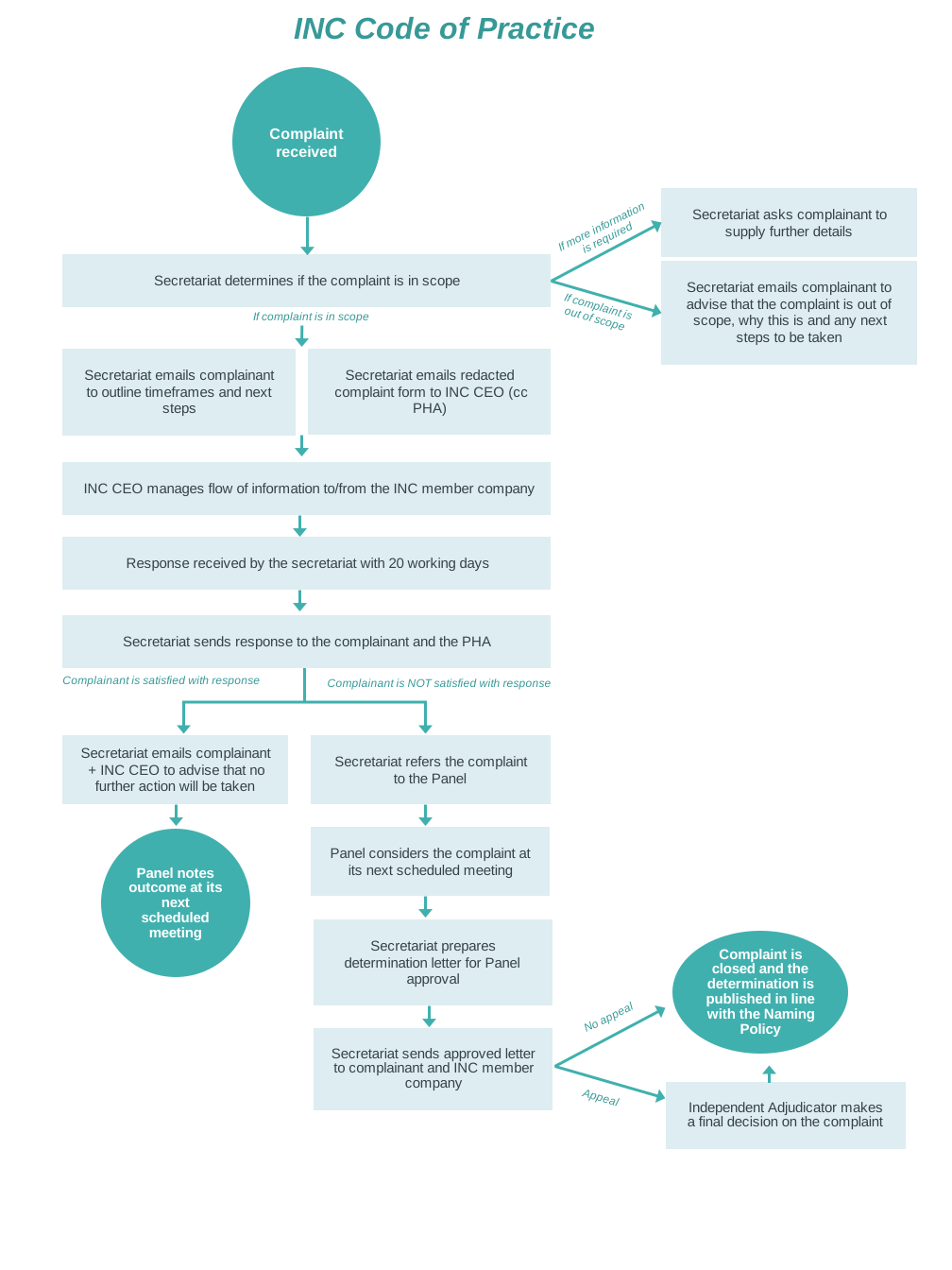
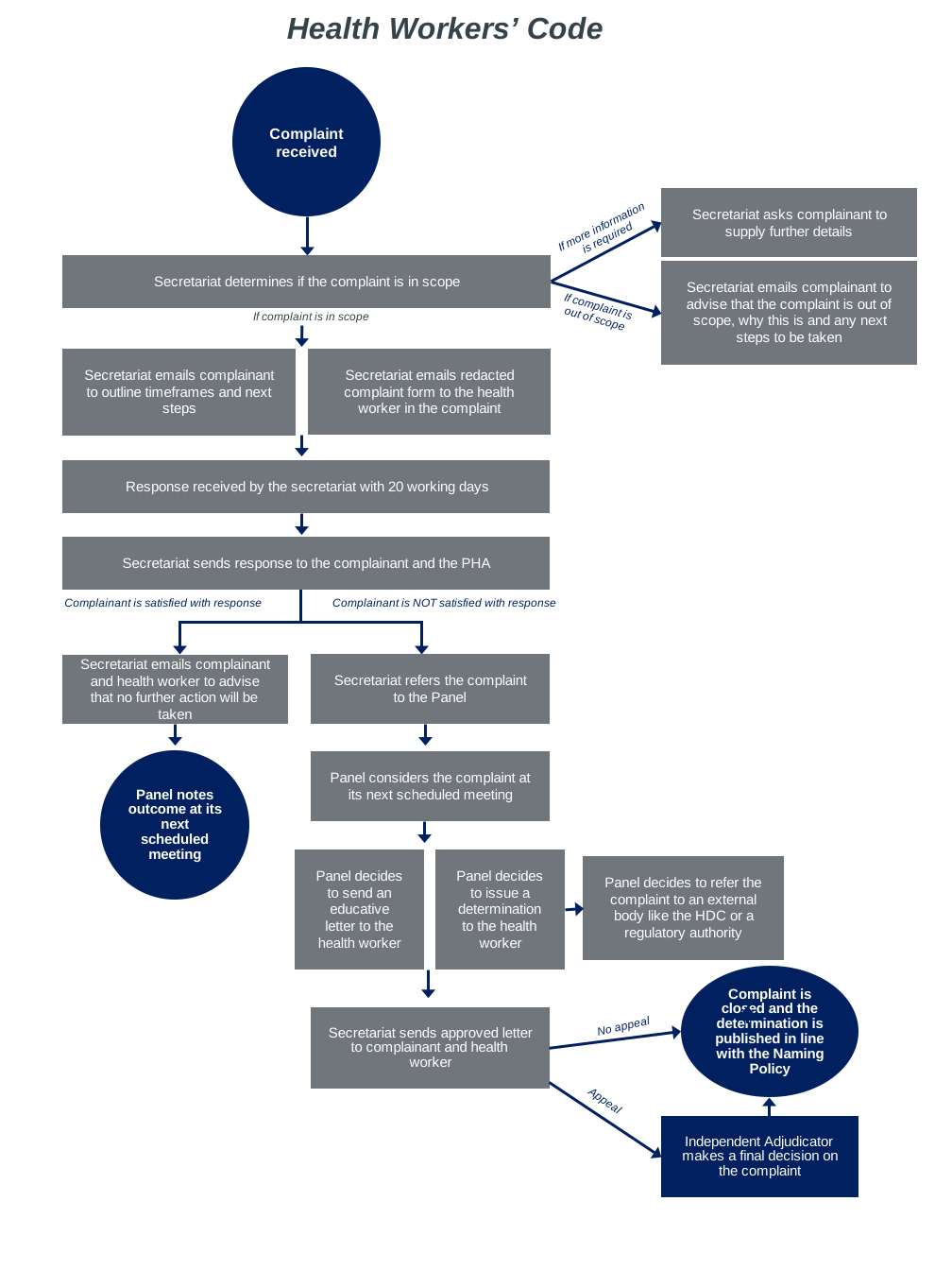
- Any person can make a complaint under either the INC Code of Practice or the Health Workers’ Code. The processes by which a complaint is received, heard and resolved is set out in the flowcharts in Appendix A.
Process for considering an appeal
- Any affected party can bring an appeal.
- The independent adjudicator receives all material relating to the Panel decision that has been appealed.
- The independent adjudicator undertakes a rigorous examination of the material put before them in an open, fair and unbiased manner, based on the principles of natural justice.
- The independent adjudicator determines whether it appears that the Panel, in making its decision:
- did not follow a fair process based on the principles of natural justice, or
- failed to take a relevant fact into consideration or took an irrelevant fact into account, or gave a relevant fact insufficient weight, or
- did not properly apply the relevant Codes in its decision.
- If the independent adjudicator determines that there are established grounds for the appeal, they consider the evidence (as presented to, and considered by, the Panel) and decide whether the Panel decision should be upheld, amended, quashed, or referred back to the Panel for re-determination.
- After receipt of the appeal, the independent adjudicator has 30 working days to consider the grounds for the appeal, make a decision and provide written reasons for their decision.
- The independent adjudicator does not consider new evidence, only the material that was considered by the Panel. Should new information be provided to the independent adjudicator by either party, the new information must be declined.
Accountability
- The Panel is accountable to the Ministry of Health via its business unit, the Public Health Agency.
Appointments
- The industry representative is nominated by the INC Board and is usually the INC Chief Executive Officer.
- Other Panel members are appointed by the Director-General of Health.
- The Chair is appointed by the Director-General of Health. Any appointed member of the Panel may be appointed as the Chair.
- Appointed Panel members do not represent the organisations for which they work or are otherwise affiliated with. If a Panel member wishes to make representations on an agency’s position or policy, they will make it clear to the Chair and the secretariat that they are putting forward an agency perspective and it will be minuted as such.
Composition of the Panel
- The Panel has five members including a Chair.
- Appointed members must include one each of:
- a legal practitioner
- a community, consumer and/or whānau representative
- a health practitioner with expertise in breastfeeding
- an academic in a field related to infant and maternal nutrition.
- The INC Chief Executive Officer (or equivalent position) represents infant formula manufacturers, importers and marketers. This membership is not appointed by the Director-General of Health.
- Collectively, the Panel has expertise in:
- relevant New Zealand legislation
- self-regulatory processes, expertise in decision-making and the application of natural justice principles
- knowledge of current scientific literature and the current evidence base relating to infant nutrition, knowledge of infant feeding practices, knowledge of and commitment to the effective implementation of the WHO International Code in New Zealand.
- Collectively, the Panel demonstrates:
- analytical and judgement skills
- ability to consider and apply the principles of te Tiriti o Waitangi as they are relevant to the objectives of the Panel
- awareness of a range of cultural contexts relating to infant nutrition especially for Māori and Pacific people and ethnic minorities
- links to the community (including caregivers of infants)
- effective communication skills.
- The Director-General of Health may from time to time alter or reconstitute the Panel at their discretion.
Term of office
- An appointed term of office is for three years.
- At the end of the maximum of two terms, members’ appointments may be extended for a period of up to eighteen months, to allow for continuity of the Panel while new appointments are made. No appointed member may hold office for more than 7.5 consecutive years unless there are exceptional circumstances.
- Appointments are staggered to ensure continuity of membership.
Resignation or removal
- An appointed Panel member may at any time resign by advising the Director-General of Health in writing (sent via the secretariat).
- An appointed Panel member may at any time be removed from office by the Director-General of Health (at their sole discretion) on grounds of inappropriate behaviour, or incapacity to discharge the functions of their office.
Managing interests and confidentiality
Managing interests
- All Panel members agree to abide by the Ministry of Health’s Conflict of Interest Protocol for Ministry of Health Advisory Committees.
- All Panel members disclose any pecuniary interests, or other potential or actual conflicts of interest in an Interests Register maintained by the secretariat. The Interests Register is shared at each Panel meeting.
- An interests declaration form must be provided to the secretariat during each individual’s appointment process to the Panel or, in the case of the industry representative, at the start of their term as the INC Chief Executive Officer.
- All Panel members perform their functions in good faith, honestly and impartially and avoid situations that might compromise the integrity of the Panel or otherwise lead to perceived or actual conflicts of interest.
- Declarations of a conflict of interest may also be made prior to discussions commencing, or as soon as it becomes apparent that a member or members may have a conflict of interest. The Chair rules on whether the member(s) should absent themselves from the meeting for that item or take some other appropriate step to manage the conflict.
- Where, outside the work of the Panel, members are involved in publications which refer to either of the INC Code of Practice or the Health Workers’ Code, members are required to specify that their views are not those of the Panel. The member must also disclose that they are a member of the Panel and the Public Health Agency should be advised in advance of any such publication.
Confidentiality
- Members observe the following duties in relation to Panel information. These provisions ensure that the Panel as a whole maintains control over the appropriate release of information.
- Members ensure that Panel documents are kept secure.
- Members are free to express their own views within the context of the Panel meetings.
- Members must not publicly comment on decisions made by the Panel.
- At no time should members individually divulge details of the Panel or decisions of the Panel to persons who are not part of the Panel or the Public Health Agency, unless this is with the agreement of the Panel.
- The Panel may from time to time authorise a Panel member to use and release information received in the course of its work if that use and release is necessary to meet the Panel’s purposes.
- The provisions of the Official Information Act 1982 apply to the activities of the Panel. This includes correspondence between members of the Panel.
Communications
- The public has a right to be informed about the final decisions of the Panel.
- The Panel follows its procedures regarding the release of final decisions. This includes developing and maintaining a Naming Policy[1].
- Queries from or contact with the media regarding the proceedings of the Panel must be referred to the Ministry of Health’s Communications Team and the secretariat as soon as possible. This includes all requests for media comment received by any Panel member, including comment on social platforms.
- Members of the Panel must not represent themselves as agents of the Public Health Agency by reason of their membership of the Panel and are not permitted to speak on behalf of the Public Health Agency.
- From time to time, the Panel may wish to issue press releases on its work. The secretariat will draft any such press releases (with the Ministry of Health’s Communications Team) and circulate this to the Panel and the Ministry of Health’s Communications Manager for comment. Any media communication will then be issued via the Ministry of Health’s channels.
- The Panel, following approval by the Public Health Agency, may authorise one or more of its members to communicate directly with the media about its work.
[1] The Naming Policy describes the Panel’s approach to identifying the subject of complaints made under either the INC Code of Practice or the Health Workers’ Code.
Meeting procedures
Frequency of meetings
- The Panel meets quarterly. Ideally, at least one meeting per annum is in person.
- Meetings are held at such times and places (including teleconferences or videoconferences) as agreed by the Chair, the majority of Panel members and the secretariat.
- Agendas and meeting papers are circulated at least five working days prior to meetings. Minutes are circulated no later than 10 days following the meeting date.
Quorum
- Quorum for each panel meeting is three members and the Chair.
Decision-making procedures
- In all its work, the Panel will:
- make decisions that appropriately apply the articles of the INC Code of Practice or the Health Workers’ Code, including determining whether the issue falls within the scope defined in the relevant Code
- debate and examine all relevant issues relating to the complaint
- make a reasoned decision in an open, fair and unbiased manner, based on the principles of natural justice
- seek further information when required before making a final decision (either from the Public Health Agency, the affected parties, the INC or any other party as is relevant)
- make decisions by consensus as far as possible
- if consensus cannot be reached, makes a decision by majority vote with each Panel member present (including the Chair) having one vote
- the way in which the decision was reached (consensus/majority) will be reflected in the decision
- makes all decisions and material relating to the decision available to the independent adjudicator for ruling on an appeal, when required
- carries out all tasks in an open and transparent manner
- makes decisions that are consistent with the Ministry of Health’s framework for applying the principles of te Tiriti o Waitangi in the health sector.
- The Panel can make decisions about complaints between scheduled quarterly meetings either via email, telephone or videoconference. If any Panel member considers that a decision should be made in a scheduled meeting instead, the item will be added to the next scheduled Panel meeting agenda.
- The Panel must not publish any decision until the appeal period has expired with no appeal lodged, or (where an appeal is lodged) the independent adjudicator’s decision has been made.
Secretariat for the Panel
- Secretariat functions include:
- organising all Panel meetings including discussing the agenda with the Chair and the Public Health Agency, ensuring appropriate input from the Panel where required
- completing meeting logistics (such as booking flights, sending meeting links, etc.)
- preparing and distributing Panel meeting agendas and papers
- preparing and circulating minutes from each Panel meeting
- preparing determinations for review by the Panel
- coordinating and managing the payment of honoraria fees to members including annual assessment of honoraria in relation to any Cabinet Office Circular updates
- drafting all correspondence arising from Panel business for review by the Chair on behalf of the Panel
- policy analysis and advice.
Reporting
- The Panel produces an annual report detailing its work for the calendar year.
Fees
- Payment of meeting and other fees is in accordance with the relevant Cabinet Office Circular for fees paid to members appointed to bodies in which the Crown has an interest. The Panel has a Group 4 classification.
- A fee is paid for attendance at meetings. Each meeting is based on a half-day meeting and a half-day of preparation time (one day in total).
- The INC Chief Executive Officer is funded by the INC.
- Public servants/state servants/employees of Crown bodies (such as the Ministry of Health, Public Health Agency or Health NZ) are not paid for meetings of the Panel. A public servant/state servant/employee of a Crown body should not retain both the fee and their ordinary pay where the duties of the outside organisation are undertaken during ordinary department or Crown body hours. Public servants/state servants/employees of Crown bodies are responsible for advising the secretariat of their eligibility for honoraria payment, noting that this may change from time to time.
- Panel members are responsible for ensuring that they pay the correct tax on honoraria paid.
- The INC is responsible for making travel arrangements for the INC Chief Executive Officer, and for the associated costs of travel.
- For all other members of the Panel, the Public Health Agency will pay for actual and reasonable travel and, if required, accommodation (within Aotearoa New Zealand) for any expenses of members accrued on Panel business, on receipt of supporting invoices. Travel to meetings (including flights) will be arranged by the secretariat. Hotel charges relating to meals, phone calls and items from the mini bar will not be paid. Any additional travel expenses incurred will be reimbursed, including taxis, mileage (at the relevant IRD kilometre rate) and parking. A valid receipt must accompany claims for expenses.
Appendix A: Process flowcharts for the INC Code of Practice and the Health Workers’ Code
Image
Image
Terms of Reference for the Independent Adjudicator
View text
Introduction
- The World Health Organisation (WHO) International Code of Marketing of Breast-milk Substitutes (the WHO International Code in New Zealand) is implemented, to the extent agreed by the Government, through three voluntary codes and one mandatory code:
- the Infant Nutrition Council Code of Practice for the Marketing of Infant Formula in New Zealand (the INC Code of Practice), which covers the activity of marketers and importers of infant formula products
- the Code of Practice for Health Workers (the Health Workers’ Code), which covers advice about infant feeding provided to families by any health worker or organisation
- the Code for Advertising of Food (administered by the Advertising Standards Authority), which covers advertisements in any media for toddler milk products (aged 12+ months)
- the Australia and New Zealand Food Standards Code (administered by the Ministry for Primary Industries), which is a mandatory code covering the safe manufacture and labelling of food products, including infant formula.
Purpose of this terms of reference
- This document sets out the objectives and purpose of the WHO Code Compliance Panel’s independent adjudicator, their purpose and terms of appointment.
Purpose of the Independent Adjudicator
- The independent Adjudicator has two roles:
- to determine if what is alleged constitutes a legitimate ground for appeal
- where required, to make a decision about that appeal.
Terms of appointment
- The independent adjudicator is appointed by the Director-General of Health.
- The independent adjudicator must have expertise in relevant New Zealand legislation and self-regulatory processes, expertise in decision-making and the application of natural justice principles.
- An appointed term of office is for three years.
- At the end of the maximum of two terms, the independent adjudicator’s appointment may be extended for a period of up to eighteen months, to allow for continuity while a new appointment is made.
- The independent adjudicator may at any time resign by advising the Director-General of Health in writing (sent via the secretariat).
- The independent adjudicator may at any time be removed from office by the Director-General of Health (at their sole discretion) on grounds of inappropriate behaviour, or incapacity to discharge the functions of their office.
The complaints and appeal process
Grounds for appeal
- The grounds for appeal are:
- the Panel did not follow a fair process based on the principles of justice
- the Panel failed to take a relevant fact into consideration or took an irrelevant fact into account, or gave a relevant fact insufficient weight or
- the Panel did not properly apply the Health Workers’ Code or the INC Code of Practice in its decision.
Process for considering a complaint
- Any person can make a complaint under either the INC Code of Practice or the Health Workers’ Code. The processes by which a complaint is received, heard and resolved is set out in the flowcharts in Appendix A.
Process for considering an appeal
- Any affected party can bring an appeal.
- The independent adjudicator receives all material relating to the Panel decision that has been appealed.
- The independent adjudicator undertakes a rigorous examination of the material put before them in an open, fair and unbiased manner, based on the principles of natural justice.
- The independent adjudicator determines whether one (or more) of the three grounds of appeal (see paragraph 10) are established.
- If the independent adjudicator determines that there are established grounds for the appeal, they consider the evidence (as presented to, and considered by, the Panel) and decide whether the Panel decision should be upheld, amended, quashed, or referred back to the Panel for re-determination.
- After receipt of the appeal, the independent adjudicator has 30 working days to consider the grounds for the appeal, make a decision and provide written reasons for their decision.
- The independent adjudicator does not consider new evidence, only the material that was considered by the Panel. Should new information be provided to the independent adjudicator by either party, the new information must be declined.
Managing interests and confidentiality
Managing interests
- The independent adjudicator agrees to abide by the Ministry of Health’s Conflict of Interest Protocol for Ministry of Health Advisory Committees.
- The independent adjudicator discloses any pecuniary interests, or other potential or actual conflicts of interest in an Interests Register maintained by the secretariat.
- An interests declaration form must be provided to the secretariat during the independent adjudicator’s appointment process.
- The independent adjudicator performs their functions in good faith, honestly and impartially and avoids situations that might compromise the integrity of the role or otherwise lead to perceived or actual conflicts of interest.
- Declarations of a conflict of interest may also be made prior to an appeal commencing, or as soon as it becomes apparent that the independent adjudicator may have a conflict of interest. The PHA rules on the action to manage the conflict.
Confidentiality
- The independent adjudicator observes the following duties in relation to Panel information.
- The independent adjudicator ensures that Panel documents are kept secure.
- The independent adjudicator must not publicly comment on decisions made by the Panel.
- At no time should the independent adjudicator divulge details of the Panel or decisions of the Panel to persons who are not part of the Panel or the Public Health Agency.
- The provisions of the Official Information Act 1982 apply to the activities of the independent adjudicator. This includes correspondence between members of the independent adjudicator and the secretariat.
Communications
- The public has a right to be informed about the final decisions of the Panel and the appeals process.
- The Panel follows its procedures regarding the release of final decisions. This includes developing and maintaining a Naming Policy[1]. The Naming Policy also applies to appeals documentation.
- Queries from or contact with the media regarding the work of the independent adjudicator must be referred to the Ministry of Health’s Communications Manager and the secretariat as soon as possible. This includes all requests for media comment received, including comment on social platforms.
- The independent adjudicator must not represent themselves as an agent of the Public Health Agency by reason of their role as the independent adjudicator and are not permitted to speak on behalf of the Public Health Agency.
[1] The Naming Policy describes the Panel’s approach to identifying the subject of complaints made under either the INC Code of Practice or the Health Workers’ Code.
Payment
- The independent adjudicator is paid at a rate determined by the Public Health Agency on a case-by-case basis. The Public Health Agency anticipates that this remuneration is likely to be within the range of $320 to $430 per appeal.
Appendix A: Process flowcharts for the INC Code of Practice and the Health Workers’ Code
Image
Image